
 • Is language first and foremost an artifact of culture? Or is it largely determined by human biology? [NY Times Review of Books]
• [R]oyal aides were puzzled as to how News of the World had gotten the information, which was known among only a small, discreet circle. They began to suspect that someone was eavesdropping on their private conversations. [New York Times Magazine]
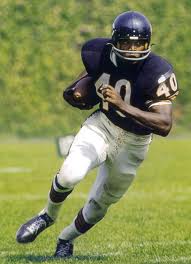
• Sayers played football more than four decades ago. His career has passed into the realm of grainy film mythology, and within that mythology certain assumptions have taken root. Such as this one: He was uniquely great. In a 68-game career from 1965 to ’71 (just 51 games in 3½ years before his first major knee injury), Sayers played running back like no other man in pads, a blinding talent who could make defenders miss him in a phone booth or outrun them in the open field. That assumption is true.
“There really has never been anybody else like him, even to this day,” says Steelers defensive coordinator Dick LeBeau, who as a defensive back for the Lions played against Sayers 10 times and has been a coach in the NFL for 37 seasons. [Sports Illustrated]
• A few months ago, a team of reporters at The Los Angeles Times and an education economist set out to create precisely such a consumer guide to education in Los Angeles. The reporters requested and received seven years of students’ English and math elementary-school test scores from the school district.
The economist then used a statistical technique called value-added analysis to see how much progress students had made, from one year to the next, under different third- through fifth-grade teachers. The variation was striking. Under some of the roughly 6,000 teachers, students made great strides year after year. Under others, often at the same school, students did not. The newspaper named a few teachers — both stars and laggards — and announced that it would release the approximate rankings for all teachers, along with their names. [New York Times Magazine]
• There has been plenty of heated debate about the state of health care for NFL players and alumni, but the discussion often centers on concussions. That’s a worthy concern—reports on the damage to the brains of dead players are beyond disturbing—but a lot of alumni leave the game with their wits about them. Their bodies, however, are as ravaged as voodoo dolls’. A sharp pain here. An odd numbness there. It is this everyday physical and spiritual anguish that in some cases leads to depression, as experts have pointed out. Now add two more games. “You’re probably talking 120 extra plays, 120 extra collisions over the course of a season,” says Gannon. [Sports Illustrated]
• Despite its dangers (or maybe because of them), tow surfing grew in popularity and visibility through the 1990s. The riders ventured onto ever more treacherous waves. They tinkered with equipment. They refined their techniques. Working in teams of two — a driver and a rider — they figured out how to rescue one another in behemoth surf. A kind of natural selection occurred: Riders who’d glimpsed their own mortality a little too closely drifted to the sidelines. At the opposite end of that spectrum was Hamilton. The more intimidating the conditions, the more he seemed to thrive. [Sports Illustrated]
• A notable array of unions, civil rights groups and law-enforcement officials has lined up to support legalization, and even Gov. Arnold Schwarzenegger has said that “it’s time for a debate” on the issue. [Rolling Stone]