
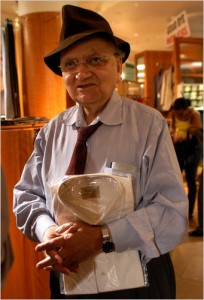
• The man, Raphael M. Klapper (pictured), an ophthalmologist and an immigrant from Poland, died in May at age 85 of complications from pancreatic cancer. Six months later, he was listed on the ballot as the Conservative Party candidate in the 31st District.
Dr. Klapper, who lived in Riverdale, never expressed an interest in running for office, family members say. But by the time polls closed, he had collected 828 votes, or about 2 percent of the total — without knocking on any doors or delivering a single speech. Adriano G. Espaillat, a Democrat, won the seat with nearly 40,000 votes. [New York Times]
• The intentions of our founders have rarely been as well articulated as they were by Justice Hugo Black 40 years ago, concurring with the Supreme Court ruling that stopped the government from suppressing the secret Vietnam War history called the Pentagon Papers: “The government’s power to censor the press was abolished so that the press would remain forever free to censure the government. The press was protected so that it could bare the secrets of government and inform the people.”
There is no neat formula for maintaining this balance. [New York Times Magazine]
• For the sake of this discussion, let’s stipulate that Loughner was a “lone nutjob” who had never listened to Glenn Beck or been a card-carrying member of either the Tea or Communist parties. Let’s also face another tragedy: The only two civic reforms that might have actually stopped him — tighter gun control and an effective mental health safety net — won’t materialize even now. [Frank Rich, New York Times]
• The Comcast lobbyists, led by executive vice president David Cohen, studied the FCC members the way NFL coaches prep for the college draft. Clyburn, they decided, held the key vote, so they courted her with plans and promises meant to convince her that the new Comcast conglomerate would be a gentle giant.
And it worked. [Philadelphia Inquirer]
• An engineer at Virginia Tech, Stefan Duma, is working to pull back the curtain on the true performance properties of helmets. He is conducting tests and compiling an online database of results, through which one will be able to look up the protective qualities and star rating of every helmet model, much as one can for cars and child booster seats. But even people who applaud Duma’s intent fear that such information could still impede the confounding process of concussion protection. [New York Times]